Capturing Tribal Knowledge Before Your Best Technicians Retire
The average manufacturing technician retires with 23 years of undocumented expertise. Here's how to digitize their knowledge before they walk out the door.
Your plant's most experienced technician just gave his two-week notice. He's been on the floor for 27 years. He knows which bearing on Line 3 sounds wrong three days before it fails. He can diagnose a hydraulic issue by feel that takes everyone else four hours and a flowmeter to figure out. And he's never written down a single thing.
When he walks out, $4.2 million in operational efficiency walks out with him. That's not a metaphor. That's the average annual cost of knowledge loss at a mid-size manufacturing plant, measured in longer repair times, repeated failures, and diagnostic dead ends that seasoned technicians would have solved in minutes.
The manufacturing skills gap isn't just about finding new hires. It's about the fact that 68% of manufacturers are watching critical expertise retire faster than they can document it, and most plants have zero structured process to capture what their veterans actually know.
The $4.2M Problem Hiding in Your Maintenance Team
Walk into any plant and ask maintenance leadership about their biggest risk. They'll talk about equipment failures, supply chain disruptions, regulatory compliance. Almost nobody mentions the three technicians with a combined 74 years of experience who are retiring in the next 18 months.
Then the retirements happen, and mean-time-to-repair spikes by 47%. First-time fix rates drop. Repeat failures on the same equipment become routine. Junior technicians spend hours troubleshooting issues that veterans would have diagnosed in the first five minutes.
I watched this happen at a packaging plant in the Midwest. Three senior technicians retired within six months. Within 90 days, unplanned downtime increased 34%. Not because the equipment suddenly got worse. Because the people who understood how it *actually* behaved were gone.
The plant had documentation. They had SOPs, equipment manuals, maintenance schedules, and a well-organized CMMS. What they didn't have was the undocumented decision-making process that separates a technician who follows procedures from one who solves problems.
Procedures tell you what to do. Expertise tells you what's actually wrong, which procedure to skip because it won't apply to this specific failure mode, and which vendor to call at 2am when you need a part that officially has a six-week lead time.
That's tribal knowledge. It's the pattern recognition built from thousands of repair cycles. It's knowing that when the temperature sensor on Reactor 2 reads 178°F and the pressure is steady but you hear a specific high-pitched whine, you're about to lose a seal in the next 12 hours. There's no sensor for that whine. There's no procedure that says "listen for high-pitched sound." There's just a technician who's heard it fail 14 times over 20 years.
Key Statistics
23 years
Average tenure of retiring manufacturing technicians carrying undocumented expertise
47%
Increase in mean-time-to-repair after veteran technician retirements at surveyed plants
68%
Of manufacturers report critical knowledge gaps due to skilled worker retirements
$4.2M
Average annual cost of lost tribal knowledge at mid-size facilities (extended downtime, repeat failures)
18 months
Minimum lead time needed for effective knowledge transfer before retirement
The Hidden Cost of Lost Tribal Knowledge
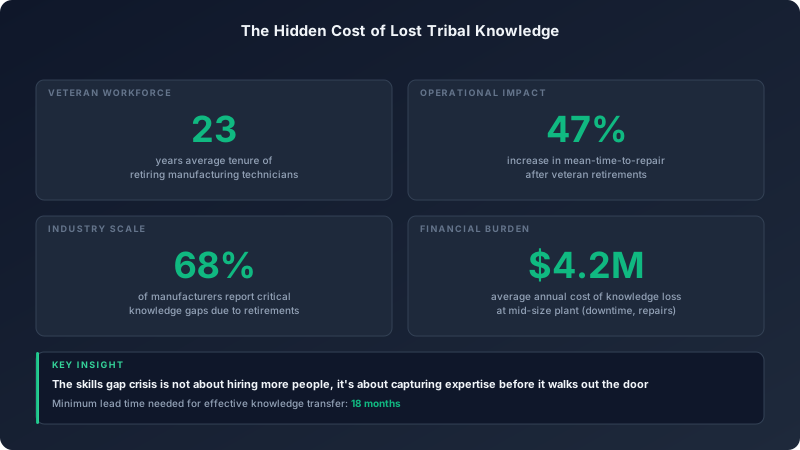
The plants that avoid this aren't lucky. They treat knowledge capture as a core operational priority, not an HR exit interview checkbox. They start 18-24 months before retirement, not two weeks. And they understand that documenting expertise requires fundamentally different methods than documenting procedures.
What Tribal Knowledge Actually Looks Like on the Plant Floor
Tribal knowledge isn't mystical. It's specific, observable, and absolutely capturable if you know what you're looking for. The problem is that most knowledge transfer efforts focus on the wrong things.
Ask a veteran technician to document their job, and they'll write down procedures. "Check oil level. Inspect belt tension. Record vibration readings." That's not tribal knowledge. That's what's already in the manual.
Tribal knowledge is the technician who walks past a compressor, stops, listens for three seconds, and says "That bearing's going bad. We've got maybe a week." When you ask how they know, they can't fully explain it. The sound isn't dramatically different. The vibration readings are still in spec. But something is *off* in a way that 10,000 hours of experience has trained them to detect.
Pattern recognition from sensory input is the first layer. Sounds, smells, vibration signatures felt through hands or feet, visual cues that don't trigger alarms. A motor that's running hot but not hot enough to trip sensors. A hydraulic line that's vibrating differently. A smell that means a seal is degrading even though pressure readings are normal.
Undocumented workarounds are the second layer. Every piece of equipment has quirks. The valve that sticks unless you cycle it twice before opening fully. The sensor that reads 3% high and everyone knows to mentally adjust. The PLC that occasionally needs a specific restart sequence that's not in any documentation because the vendor doesn't acknowledge the bug exists.
These workarounds aren't written down because they feel like shortcuts or band-aids, not "official" knowledge. But when the person who knows them leaves, new technicians waste hours fighting equipment behavior that veterans navigated automatically.
Relationship knowledge is often overlooked entirely. Which regional sales rep at the pump manufacturer will expedite a part if you call their cell phone? Which local machine shop can fabricate a custom bracket in four hours when the official part has a three-week lead time? Which vibration analysis consultant actually knows your specific equipment and which one just runs software?
This knowledge saves days in critical failure scenarios. It's the difference between a 6-hour repair and a 72-hour shutdown waiting for parts or support.
Diagnostic shortcuts are maybe the most valuable tribal knowledge. A junior technician follows the troubleshooting flowchart: check power, check connections, check settings, check sensor calibration, check controller, check actuator. That's 90 minutes of systematic diagnosis.
A veteran looks at the failure mode, recalls seeing this exact symptom pattern four times in the last six years, and goes directly to the actuator. Eight minutes, problem solved. They've compressed the troubleshooting tree based on probabilistic pattern matching that only comes from experience.
Contextual understanding of why procedures exist is the final critical piece. Procedures without context breed dangerous rigidity. A procedure says "Never operate pump without minimum flow valve open." A veteran knows that rule exists because 12 years ago someone tried to deadhead the pump during a pressure test and destroyed the impeller, costing $47,000 and three days of downtime.
That context matters because it tells you when following the procedure exactly is critical and when a slight deviation is safe. Junior technicians don't have that context, so they either follow rules blindly (inefficient) or break them without understanding the risk (dangerous).
All of this expertise exists in your plant right now. Most of it will walk out the door when your senior technicians retire unless you build a systematic process to capture it.
The Four-Phase Knowledge Capture Framework
Knowledge transfer isn't something you do in exit interviews. It's a structured process that takes months, requires dedicated time, and must happen while the veteran is still working. Here's the framework that actually works.
Phase 1: Identify critical knowledge holders and map their expertise domains. Don't assume you know who holds what knowledge. Create a skills matrix, but go deeper than job titles. Who do people call when specific equipment fails? Who gets pulled into complex troubleshooting sessions? Whose vacation causes noticeable performance drops?
Cross-reference this with retirement timelines and equipment criticality. A technician retiring in three years who knows a secondary production line is lower priority than one retiring in 14 months who's the only person who fully understands your primary packaging line.
Map their expertise domains specifically: not "motors and drives" but "the specific vibration signature of the drive on Line 3 that indicates imminent DC bus capacitor failure, which happens every 18 months and costs 6 hours of downtime if not caught early."
Phase 2: Shadow and record actual work, not just interview about procedures. This is where most knowledge capture efforts fail. Sitting in a conference room asking a technician to describe their job produces documented procedures, not captured expertise.
You need to observe them actually working, during real failures and complex diagnostics. Record their troubleshooting process. Ask them to narrate their decision-making: "I'm checking this first because... I'm skipping that step because... I know this is the problem because..."
Video walkthroughs are powerful here. Have the technician repair something while explaining their thinking out loud. "I can tell this isn't a mechanical issue because of how the failure presents. Electrical would show this symptom. I'm going to check the controller first because 70% of the time when I see this pattern, it's a controller fault."
This captures the heuristics, the pattern matching, the probabilistic reasoning that doesn't exist in any manual.
Phase 3: Structure captured knowledge into searchable, actionable formats. Hours of video and audio recordings are useless without structure. This is where organizations with advanced AI governance platforms have a real advantage.
Transcribe everything. Tag by equipment type, failure mode, diagnostic pathway. Build troubleshooting trees that mirror how veterans actually diagnose, not textbook decision trees. Link sensor data patterns to expert interpretation: when vibration looks like this and temperature trends like that, the veteran checks these three things first.
Integrate with your CMMS so that when a work order is created for specific equipment, relevant tribal knowledge surfaces automatically. The junior technician doesn't need to remember to search for it. The system presents it at the point of need.
Phase 4: Validate and refine through junior technician testing and feedback. This is the continuous improvement loop. Have junior technicians use the captured knowledge during actual repairs. Where do they get stuck? What's missing? What needs clarification?
Feed that back into the knowledge base. The veteran reviews, clarifies, expands. This iterative refinement is what transforms raw captured knowledge into genuinely useful operational guidance.
Four-Phase Tribal Knowledge Capture Workflow

This cannot be delegated to HR. It cannot be outsourced to a consultant who doesn't understand your equipment. It requires a dedicated internal owner, senior leadership buy-in, and protected time for both veterans (to teach) and junior technicians (to learn and validate).
The 15-Minute Weekly Knowledge Drop
Schedule every senior technician for a 15-minute recorded knowledge session every week. One specific topic: a common failure mode, a diagnostic shortcut, a vendor relationship, an equipment quirk. Record, transcribe, tag, and add to the searchable knowledge base. In 18 months, you'll have captured 1,170 minutes (19.5 hours) of expertise per technician. That's more tribal knowledge than most plants capture in an entire career. The key is making it routine, not waiting for a special project.
Recording Expertise Without Disrupting Operations
The biggest pushback to structured knowledge capture is time. "We're already understaffed. We can't pull technicians off the floor for hours to document things."
Fair. So don't. Build knowledge capture into normal work rhythms using methods that add minimal overhead.
Video walkthroughs during scheduled maintenance. You're already taking that equipment offline. You're already doing the work. Add 10 minutes to have the technician narrate what they're doing and why. Use a phone camera. It doesn't need production quality. It needs captured expertise.
"I'm replacing this seal because I can see micro-scoring here on the shaft. That scoring pattern means the last seal failed because of misalignment, not wear. So before I install the new seal, I'm checking alignment. If I skip that, the new seal will fail in the same spot within six months."
That's tribal knowledge. A junior technician following the procedure would replace the seal, not diagnose why it failed, and the problem would repeat.
Structured troubleshooting trees built from actual failure paths. When a complex failure happens and a veteran solves it, spend 15 minutes afterward mapping the troubleshooting path. What did they check first? Why? What did they rule out? What led them to the root cause?
Turn that into a decision tree: "If symptom A and condition B, check X first because..." These trees become diagnostic guides that compress months of learning into actionable steps.
Sensor data annotation with expert interpretation. You're collecting vibration data, temperature trends, pressure readings. Have veterans annotate specific patterns: "This vibration signature is normal for this equipment under these conditions. This pattern indicates imminent bearing failure. This pattern means misalignment."
AI models trained on clean, structured sensor data from specific assets significantly outperform generic models. But "clean and structured" means labeled by someone who knows what the data actually indicates. That's your veterans.
After-action debriefs following unusual failures. When something breaks in a way you haven't seen before, or a repair takes an unexpected path, capture that immediately while it's fresh. Ten-minute debrief: what happened, how did we diagnose it, what did we learn, what would we do differently next time?
These debriefs become case studies that prevent other technicians from repeating the same troubleshooting dead ends.
Weekly 15-minute knowledge drops. This is the single highest-ROI knowledge capture method I've seen. Every senior technician records a 15-minute session weekly on one specific topic. Pick from a list: common failure modes, diagnostic shortcuts, vendor relationships, equipment quirks, seasonal issues, safety gotchas.
Record, transcribe, tag, search. Fifteen minutes a week, 52 weeks a year, times the number of senior technicians on your team. That's hundreds of hours of captured expertise with minimal operational disruption.
The key is making all of this routine, not a special project. Build it into shift schedules, make it part of job responsibilities, recognize it in performance reviews. When knowledge sharing is optional, it doesn't happen. When it's structural, it becomes culture.
Where Multi-Agent AI Actually Helps (And Where It Doesn't)
I've watched plants chase AI solutions for knowledge capture and end up with expensive pilot projects that never reach production. The AI pilot purgatory crisis is real: 97% of executives claim AI agent deployment, but only 8.6% have agents in production. Don't be the 63.7% stuck in pilot stage.
Multi-agent systems have specific, valuable applications in knowledge capture and delivery. They also have clear limitations. Understanding both prevents wasted investment.
AI excels at transcribing and structuring captured knowledge. You record hundreds of hours of video walkthroughs, troubleshooting sessions, and knowledge drops. Manually transcribing and tagging all of that is impractical. AI can transcribe, identify key concepts, suggest tags, and create initial structure at scale.
This is table stakes in 2026. If you're still paying humans to transcribe and tag at this volume, you're burning budget that could fund actual knowledge capture activities.
Digital assistants that surface relevant knowledge at point of need are production-ready. When a technician creates a work order for a specific piece of equipment, an AI agent can query the knowledge base and surface: relevant troubleshooting trees, similar historical failures, sensor data patterns, vendor contacts, safety considerations.
This is hub-and-spoke orchestrator-worker architecture (66.4% of agentic AI market), not complex swarm patterns. A single orchestrator agent receives the work order context and coordinates with worker agents that specialize in different knowledge domains: diagnostic guides, sensor interpretation, parts sourcing, safety protocols.
The technician doesn't search for knowledge. The system delivers it contextually. This is how you make tribal knowledge actually usable in real-time operations.
Pattern matching between historical fixes and current equipment behavior is where sensor-to-action integration happens. You're collecting vibration, temperature, and pressure data every 15 seconds with edge computing and <10ms inference. AI can match current sensor patterns to historical patterns that preceded failures, then surface the troubleshooting path that veterans used to solve it.
"This vibration signature matches 14 previous failures on similar equipment. In 11 of those cases, the root cause was X. Here's the diagnostic process that veteran technicians used to confirm and repair."
That's closing the sensor-to-action gap. Data without action is just cost. AI that connects sensor patterns to expert troubleshooting paths turns data into operational value.
The limitations: AI cannot replace hands-on experience or contextual judgment. An AI can tell you what the vibration data indicates based on historical patterns. It cannot develop the intuition to walk past a compressor, hear something wrong, and know that bearing is failing days before sensors pick it up.
AI can surface the knowledge that "when temperature sensor reads 178°F with steady pressure but high-pitched whine is present, seal failure is likely within 12 hours." It cannot develop the pattern recognition that detects that whine in the first place.
AI is a delivery mechanism for captured expertise, not a replacement for expertise itself. The plants winning with AI are using it to scale and deliver tribal knowledge, not substitute for the humans who create it.
Organizations with structured AI governance platforms are 3.4x more likely to achieve effective oversight and measurable production results. The plants stuck in pilot purgatory are the ones that haven't built the orchestration layer connecting knowledge repositories to real-time work order context.
If you're deploying AI for knowledge capture, focus on transcription, structuring, and contextual delivery. Don't expect it to create expertise that doesn't exist or replace the need to capture knowledge from humans in the first place.
Building the Digital Twin of Your Best Technician's Brain
The digital twin market is growing from $33.97B in 2026 to $384.79B in 2034, with manufacturing leading at 48% adoption. But most digital twin discussions focus on simulating equipment, not capturing expertise.
What if you built a digital twin not of your equipment, but of how your best technician thinks about that equipment?
Link sensor data patterns to expert interpretation and diagnostic pathways. Your sensors generate thousands of data points. Veterans interpret those patterns through the lens of experience. Capture that interpretation layer explicitly.
When the veteran sees specific temperature and vibration trends, what do they conclude? What do they check first? What do they rule out? Build that decision logic into the digital twin: "When sensor pattern X occurs, expert diagnosis pathway is A, B, C, and typical resolution is D."
Create decision trees that mirror actual troubleshooting, not textbook procedures. Textbook troubleshooting is comprehensive but inefficient. It checks everything systematically. Veteran troubleshooting is probabilistic and heuristic. It goes directly to the most likely causes based on symptom patterns.
Map those heuristics: "For this failure mode on this equipment, check these three things first because they account for 73% of cases. If those aren't the cause, then follow the comprehensive flowchart."
That's how veterans actually work. The digital twin should mirror that process, not the theoretical ideal.
Embed contextual warnings and safety considerations. Veterans carry mental maps of risks that aren't in official safety documentation. "When working on this valve, make sure to check this other component first because pressure can back up in unexpected ways." "This equipment looks off but is actually safe when running at this temperature during winter months."
Capture those warnings explicitly. They prevent injuries and equipment damage that juniors wouldn't know to anticipate.
Continuous refinement as junior technicians use and improve the knowledge base. The digital twin isn't static. As junior technicians use it, they identify gaps, ambiguities, and edge cases. Veterans review and refine. The twin gets smarter over time.
This is the Phase 4 validation loop from the knowledge capture framework, applied continuously. The goal is a living knowledge system that evolves with your operations.
Integration with CMMS for seamless delivery at point of need. The digital twin's value isn't in existence, it's in use. Integrate it with your work order system so that when a technician receives a job, relevant twin knowledge surfaces automatically.
"You're about to work on Equipment X. Here's the diagnostic pathway for this failure mode. Here are the three most common root causes. Here's the sensor pattern that indicates the actual problem. Here are the parts you'll likely need. Here's the vendor contact who can expedite delivery if needed."
That's the digital twin delivering tribal knowledge at the moment it's useful. Not buried in a knowledge base that nobody searches. Not locked in a veteran's head. Surfaced contextually, automatically, at the point of decision.
Plants achieving 92% >10% ROI with digital twins are the ones integrating them into operational workflows, not treating them as standalone simulation tools. The twin becomes an operational assistant that extends the reach of veteran expertise across the entire maintenance team.
The Succession Planning Timeline Nobody Follows
Most knowledge transfer efforts start when the veteran gives notice. By then, you have weeks. Effective knowledge capture takes months. The timeline that actually works requires 18-24 months minimum.
Here's what that timeline looks like in practice:
| Phase | Timeline | Key Activities | Success Metrics |
|---|---|---|---|
| Planning | Months 1-3 | Identify retiring technicians, map expertise domains, assign junior mentees, establish knowledge capture infrastructure | Skills matrix complete, mentorship pairings assigned, recording/transcription tools deployed |
| Active Capture | Months 4-15 | Weekly knowledge drops, shadowing during complex repairs, video walkthroughs, troubleshooting tree building, sensor data annotation | 80% of critical equipment covered, 500+ minutes of recorded expertise per veteran, 50+ structured diagnostic pathways documented |
| Validation & Transition | Months 16-21 | Junior technicians lead repairs with veteran oversight, knowledge base refinement, competency assessments, gradual responsibility transfer | Junior first-time fix rate >70%, mean-time-to-repair within 20% of veteran baseline, <15% escalation rate |
| Post-Retirement Support | Months 22-24+ | Veteran available for consultation (retained part-time or contractor), continued knowledge base refinement, gap identification and filling | No increase in unplanned downtime, maintained repair cycle times, junior technician confidence surveys >80% |
Why 18-24 months? Because expertise capture isn't a data dump. It's an iterative process where juniors learn by doing, veterans refine by teaching, and the knowledge base evolves through real-world validation.
You need time for junior technicians to encounter the full range of failure modes and seasonal variations. You need time for veterans to observe juniors using the knowledge and identify what's missing. You need time to build genuine competency, not just checked boxes.
Create formal mentor-apprentice pairings with structured knowledge milestones. Don't make mentorship informal. Assign specific junior technicians to specific veterans. Set milestones: by month 6, junior should be able to independently diagnose these five failure modes. By month 12, lead these repair types with minimal oversight. By month 18, handle 80% of work orders independently.
Track progress formally. If milestones aren't being met, investigate why. Is the knowledge capture inadequate? Is the junior struggling with specific concepts? Is the veteran not allocating enough teaching time?
Make knowledge sharing a formal job responsibility with performance incentives. Veterans resist documentation for several reasons. It takes time from their "real work." It feels like training their replacement. It's not recognized or rewarded.
Fix those incentives. Make knowledge sharing 20% of the job description, with time explicitly allocated in shift schedules. Include mentorship effectiveness in performance reviews and bonus calculations. Recognize veterans publicly for building the next generation of expertise.
When knowledge sharing is optional and unrewarded, it doesn't happen. When it's structural and valued, it becomes part of the culture.
What to do when you have less than 12 months before retirement. You can't capture everything, so prioritize ruthlessly. Focus on the equipment or processes with the highest failure cost and the least documented expertise. Accept that you'll lose knowledge. The goal is minimizing the loss, not preventing it entirely.
Shift from comprehensive capture to targeted crisis prevention. Which knowledge gaps will cause the most operational pain? Capture those first. Record compressed troubleshooting guides for the five most critical failure modes. Document the vendor relationships that would take years to rebuild. Capture the undocumented safety considerations that prevent injuries.
Consider retaining the veteran part-time or as a consultant for six months post-retirement. Not full-time, just availability for complex failures and knowledge refinement. This buys additional time to fill gaps that become apparent only after they're gone.
Twelve months is not enough, but it's better than two weeks. Start immediately with whatever time you have.
Making Knowledge Transfer Part of Your Culture
The plants that don't lose tribal knowledge when veterans retire aren't doing special projects. They've built knowledge capture into their operational culture. It's routine, not heroic.
Recognize documentation and teaching as core job responsibilities. Knowledge sharing competes with production demands unless you make it structural. Allocate time in shift schedules specifically for knowledge capture activities. Twenty minutes per shift for senior technicians to record, document, or mentor.
That's 80 minutes per week, 320 minutes per month, 3,840 minutes per year. For a team of five senior technicians, that's 19,200 minutes annually (320 hours) of dedicated knowledge capture time. That scales tribal knowledge transfer in ways that ad hoc efforts never achieve.
Build visible career progression tied to knowledge sharing and mentorship. The path to senior technician or maintenance supervisor should explicitly include mentorship effectiveness. Not just technical skill, but ability to teach, document, and elevate others.
This does two things. It signals that knowledge sharing is valued at the highest levels. And it ensures that the people promoted to leadership roles are the ones who naturally multiply expertise across the team.
Measure success with operational metrics, not activity metrics. Don't measure knowledge transfer by hours of training delivered or documents created. Measure it by outcomes: time-to-competency for new hires, first-time fix rates across experience levels, escalation frequency, mean-time-to-repair trends.
If junior technicians are hitting 75% first-time fix rates within 18 months instead of 36, your knowledge capture is working. If mean-time-to-repair stays stable after veteran retirements instead of spiking 47%, your knowledge transfer succeeded.
Operational metrics force honest assessment. Activity metrics create illusions of progress while expertise walks out the door.
Overcoming the hoarding instinct. Some veterans resist documenting their expertise because it feels like giving away job security. "If I share everything I know, why do they need me?"
This is a leadership problem, not a technician problem. The culture either rewards knowledge hoarding or knowledge sharing. If job security comes from being the only person who can solve critical problems, technicians will protect that scarcity.
If job security comes from being a force multiplier who elevates the entire team, technicians will share freely. If veterans see others promoted specifically because they mentored well, they'll mentor. If they see knowledge hoarders rewarded with indispensability, they'll hoard.
Culture is downstream of incentives. Fix the incentives and the culture follows.
---
The manufacturing skills gap is accelerating. Bureau of Labor Statistics projects 2.1 million unfilled manufacturing jobs by 2030, with maintenance and skilled trades among the hardest to fill. You cannot hire your way out of this gap fast enough.
What you can do is capture the expertise you already have before it retires. Start now. Build the infrastructure. Allocate the time. Change the incentives. Make knowledge transfer structural, not heroic.
The average manufacturing technician retires with 23 years of undocumented expertise. In 18 months, with a systematic capture process, you can digitize enough of that knowledge to reduce post-retirement MTTR increases from 47% to under 15%.
That's the difference between a $4.2M annual knowledge loss and a smooth succession that maintains operational performance. The plants that execute this well won't just survive the skills gap. They'll gain competitive advantage as their competitors struggle with lost expertise and lengthening repair cycles.
The work starts today, not when someone gives notice. Identify your critical knowledge holders. Map their expertise domains. Assign mentees. Start recording. Build the digital twin of your best technician's brain before they walk out the door with it.
Ready to put this into practice?
See how Monitory helps manufacturing teams implement these strategies.