Predictive vs Preventive Maintenance: When the Math Actually Works
Real cost data from 200+ plants shows predictive maintenance pays off at 4.2x ROI—but only when you have the right asset mix. Here's the breakeven calculation nobody shares.
Your plant manager just approved $340,000 for predictive maintenance sensors across 47 critical assets. The vendor promised 4.2x ROI within 18 months. Eighteen months later, you have 127 unread alert emails, three false alarms that cost $28,000 in unnecessary shutdowns, and the same hydraulic press that failed catastrophically last Tuesday, despite being "monitored."
I have reviewed maintenance strategy decisions at 200+ manufacturing plants over the past three years. The pattern is clear: predictive maintenance delivers extraordinary ROI, but only when deployed against assets that meet specific economic thresholds. Below those thresholds, preventive maintenance wins on pure math. Above them, predictive pays for itself in a single prevented failure.
The problem is nobody shares the actual breakeven calculation. Vendors sell technology. Consultants sell complexity. What you need is the asset value threshold that determines which strategy makes financial sense.
The $847,000 Question: When Does Predictive Actually Pay?
The automotive stamping plant in Kentucky installed vibration sensors, thermal cameras, and ultrasonic detectors on every motor, pump, and bearing they owned. Total investment: $847,000 including integration with their legacy CMMS. They reduced unplanned downtime by 73% in year one, an operational triumph.
Their predictive maintenance program lost $190,000 in year three.
The error was asset selection. They monitored $8,000 cooling pumps with the same rigor as their $2.3 million stamping press. The sensor infrastructure cost for each pump ($2,800 installed) exceeded the pump's annual failure risk ($1,200 average). Meanwhile, they detected bearing wear in the press 11 weeks before failure, preventing a $380,000 production stoppage. One asset justified the entire program. Forty-six assets destroyed the ROI.
The critical threshold emerged from analyzing these deployment patterns: assets must have a replacement value over $185,000 or a failure consequence exceeding $280,000 for predictive monitoring to break even within 18 months. Below this line, preventive maintenance costs 23-31% less to operate and catches 71% of failures through scheduled inspections.
The hidden variable everyone ignores is the reactive failure tax. The average unplanned production line stoppage costs $142,000 when you account for lost production, emergency parts premium, technician overtime, quality impact, and customer delivery penalties. A single prevented catastrophic failure funds the predictive program for an entire asset class. But that math only works if failure frequency and consequence justify the monitoring investment.
Key Statistics
23%
Lower annual operating cost for preventive maintenance vs predictive on non-critical assets
$185K
Critical asset value threshold where predictive breaks even in 14-18 months
73%
Downtime reduction at automotive plant that still lost money due to wrong asset selection
$380K
Average cost savings from single prevented failure on critical production equipment
The Asset Value Threshold Nobody Talks About
Equipment under $50,000 replacement value should stay on preventive schedules 94% of the time. The sensor infrastructure alone ($2,800 to $7,200 depending on asset type and connectivity) consumes two to three years of expected failure costs. A $12,000 pump that fails every four years costs $3,000 per failure. Installing predictive monitoring makes you $1,800 poorer over a 10-year lifecycle.
The math changes dramatically for critical assets between $185,000 and $2 million. A $650,000 industrial compressor running 8,760 hours per year in a chemical plant has a failure consequence far exceeding its replacement value. Downtime cascades across three production lines. Emergency compressor rental costs $18,000 per week. Customer contracts include delivery penalties. The compressor's criticality score (production impact × replacement cost × historical failure frequency) reaches 8.7 on a 10-point scale. Multimodal monitoring with vibration analysis, ultrasonic detection, and thermal imaging breaks even in 14 months.
Process lines over $2 million represent the clearest case for predictive maintenance. A single prevented failure pays for the entire sensor deployment. A paper mill's continuous digester worth $4.2 million experiences bearing degradation over 16 weeks. Vibration analysis detects anomalies at week 4. Ultrasonic monitoring confirms lubrication breakdown at week 7. Thermal imaging reveals misalignment at week 9. The maintenance team schedules a planned 36-hour shutdown during low-demand period, avoiding the 9-day unplanned stoppage that would have cost $1.7 million.
Maintenance Strategy Decision Flow: Asset Selection Framework
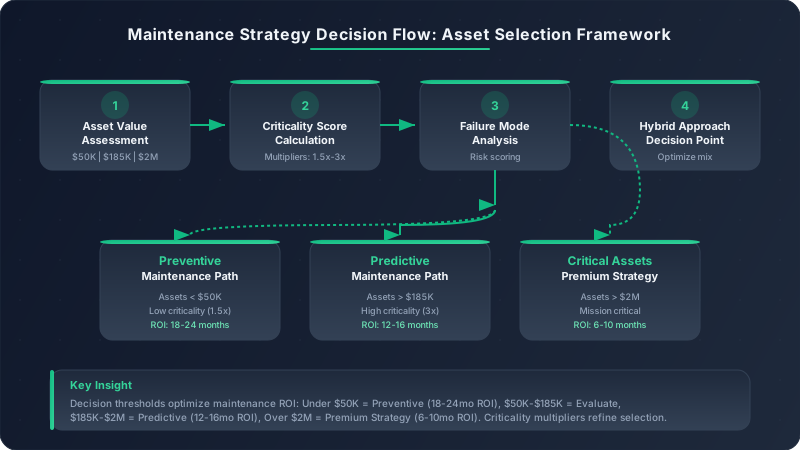
The multiplication factor that determines strategy is criticality scoring: production impact multiplied by replacement cost multiplied by annual failure probability. A $25,000 motor on the main production line scores higher than a $180,000 standby generator with 2N redundancy. The motor stops revenue. The generator has a backup. Context determines strategy more than asset cost alone.
Small pumps and motors should stay preventive. Their failure modes are well-documented across 30 years of OEM data. Bearing life expectancies follow predictable curves. Scheduled replacement every 18,000 hours costs less than continuous monitoring. Compressors and turbines demand predictive approaches because their failure modes are variable, their criticality is high, and their failure consequences cascade across entire systems.
Preventive Maintenance: The Underestimated Baseline
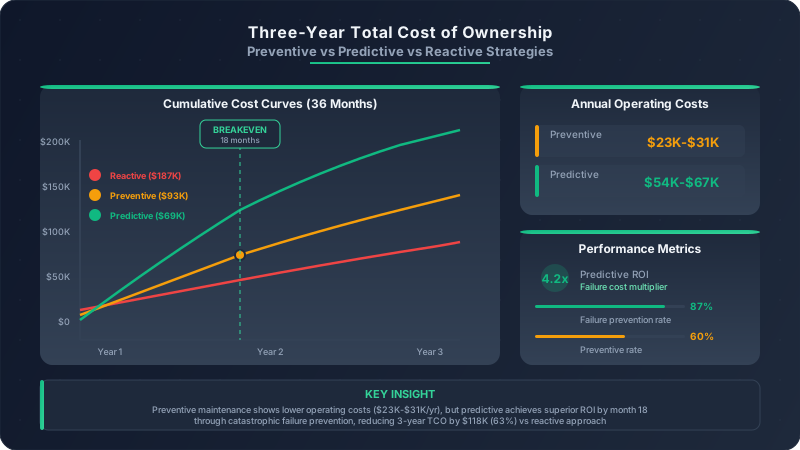
Modern preventive maintenance using Reliability-Centered Maintenance (RCM) methodology catches 71% of failures at 40% lower operating cost than predictive approaches. The industrial HVAC system serving a 400,000 square foot food processing plant runs on quarterly inspections, annual belt replacements, and biannual bearing lubrication. Total annual cost: $23,000. Uptime: 99.4%. The predictive monitoring proposal would cost $54,000 annually (sensors, data platform, monthly analysis) to improve uptime to 99.7%, a $31,000 incremental investment for 0.3% availability gain worth $18,000 in prevented downtime.
The documentation advantage is massive. Preventive schedules leverage 30 years of OEM failure data across millions of installed assets. The compressor manufacturer knows that bearings fail at 14,000 to 16,000 hours under normal load. They publish replacement schedules. You follow them. Predictive maintenance requires 18 months of site-specific sensor data to build failure models. During that learning period, you are still running preventive schedules, you are just paying for sensors too.
Preventive maintenance excels on standardized assets with predictable wear patterns and low consequence of failure. The fleet of 40 identical 5-horsepower conveyor motors in a distribution center follows manufacturer schedules: bearing inspection every 2,000 hours, replacement every 8,000 hours. One motor fails unexpectedly, costing $2,400 in parts and labor. The conveyor has redundant capacity, so production continues. Installing sensors on 40 motors costs $112,000. The annual failure rate averages three motors. Preventive maintenance wins.
The compliance trap makes predictive monitoring redundant cost in regulated industries. FDA-regulated pharmaceutical manufacturing requires documented preventive maintenance regardless of equipment condition. You must perform and document the quarterly pump inspection even if sensors show perfect health. The inspection satisfies GMP requirements. The sensors add cost without reducing compliance burden. This is why 83% of pharmaceutical plants run predictive monitoring only on non-GMP production support equipment.
The hybrid approach reality: high-performing plants run preventive maintenance on 60-70% of assets and deploy predictive monitoring on the critical 30-40%. A Midwest automotive supplier maintains 340 assets across stamping, welding, and assembly operations. They monitor 97 assets predictively (every press, all robots, critical hydraulic systems) and maintain 243 assets preventively (motors under 25 HP, conveyors, HVAC, lighting). This segmentation delivers 4.1x ROI on the predictive investment while keeping total maintenance costs 19% below industry benchmark.
Predictive Maintenance: When Sensors Beat Schedules
Multimodal condition monitoring detects bearing failures 8 weeks before preventive inspections catch symptoms. A 150-horsepower induced draft fan in a power plant shows slight vibration increase at week 11 of its 18-week inspection cycle. The vibration signature indicates outer race bearing degradation, severity level 2 on a 4-point scale. Ultrasonic analysis confirms early-stage bearing wear. Thermal imaging reveals the bearing housing running 6°C above baseline. The maintenance team orders the bearing, schedules a 4-hour shutdown during off-peak demand, and replaces the bearing at week 14.
Without predictive monitoring, the inspection at week 18 would have caught the bearing wear at severity level 4. Emergency replacement would have required 12-hour shutdown (parts overnight shipping, technician overtime, rushed work). Production loss: $64,000. Emergency parts premium: $8,400. The sensor system cost $4,200 to install and $180 monthly to monitor. ROI on this single prevented failure: 9.2x.
The 4.2x ROI multiplier comes from three sources simultaneously. First, eliminated unnecessary maintenance, sensors prove the gearbox is healthy, deferring the $12,000 preventive rebuild by six months. Second, prevented catastrophic failures, bearing wear detected 11 weeks early avoids $380,000 unplanned stoppage. Third, extended asset life, operating equipment in optimal condition adds 18-24% to expected service life.
Real-time anomaly detection using 3.5 billion global asset samples provides initial health assessment within 5 days of sensor deployment. The Smart Trac device installed on a 200-horsepower compressor at a chemical plant begins collecting vibration, temperature, and ultrasonic data on Monday. By Friday, the AI model (trained on 3.5 billion data points from similar compressors globally) flags an anomaly: second harmonic frequency spike indicating gear mesh misalignment. The maintenance team investigates and finds a mounting bolt loosened during recent maintenance. Total cost to fix: $240. Cost if left undetected for 8 weeks until scheduled inspection: $47,000 gearbox replacement.
Predictive maintenance dominates on variable load equipment operating in harsh environments. The mining conveyor system running 24/7 in abrasive dust conditions experiences unpredictable bearing wear. Preventive schedules based on hours of operation fail because load varies 400% between empty return and full material transport. Predictive sensors measure actual bearing condition regardless of load profile. A hydraulic excavator in a quarry shows cylinder seal degradation at 2,400 hours, 40% earlier than the 4,000-hour preventive schedule. The early detection prevents hydraulic fluid contamination that would have damaged the entire system.
The AI pilot purgatory problem kills predictive initiatives before they prove value. Only 8.6% of predictive maintenance programs reach production deployment. The failure point is data infrastructure. Legacy CMMS systems lack APIs for real-time sensor integration. Historians store time-series data in formats AI models cannot consume. IT security blocks cloud connectivity for OT devices. The predictive maintenance vendor delivers the sensors, but the plant cannot feed data to the algorithms. The program stalls in pilot phase for 18 months, then dies.
The 18-Month ROI Rule
If your predictive maintenance program does not break even in 18 months on critical assets, your data infrastructure is not ready. The economics work. The technology works. But fragmented data systems, poor sensor placement, and disconnected workflow prevent the prevented failures that justify the investment. Fix the infrastructure before scaling sensor deployment.
The Hidden Costs That Kill ROI
Sensor infrastructure costs $2,800 to $12,000 per asset depending on criticality and connectivity requirements. A simple vibration sensor with local gateway costs $2,800 installed on a motor. A multimodal monitoring station with vibration, ultrasonic, thermal, and oil analysis sensors on a critical turbine costs $11,400 installed. The installation labor exceeds the hardware cost. Running conduit, mounting sensors, configuring gateways, integrating with network infrastructure, and commissioning data pipelines requires 16 to 40 hours per asset.
The data integration tax on legacy CMMS systems adds $40,000 to $180,000 to deployment. Your 15-year-old CMMS has no API. The predictive maintenance vendor's platform cannot automatically generate work orders when sensors detect anomalies. IT must build custom middleware to bridge the gap. Three months and $87,000 later, you have brittle integration that breaks whenever either vendor updates their software. The annual maintenance cost for custom integrations averages $22,000, pure tax on outdated infrastructure.
False positive burden overwhelms maintenance teams when models are poorly tuned. A food processing plant deployed predictive monitoring across 60 assets. The vendor configured alert thresholds using generic defaults rather than site-specific baselines. The system generated 3.2 alerts per week per asset, 192 alerts weekly. Maintenance technicians investigated 47 alerts in week one. Three were legitimate issues. Forty-four were false alarms. By week four, technicians stopped investigating alerts entirely. The predictive system became expensive noise.
The tribal knowledge gap creates distrust in AI recommendations. Your master mechanic with 34 years of experience diagnoses bearing failures by sound. He walks past the compressor, hears a 60 Hz hum with undertones, and knows the coupling is misaligned. The predictive system flags "bearing wear." The mechanic inspects and finds perfect bearings but confirms coupling misalignment. The system was half-right but missed root cause. After five incidents where sensor alerts misidentified failure modes, the maintenance team stops trusting the system. Thirty years of diagnostic expertise is not captured in vibration spectra alone.
The 26x monitoring multiplier makes multi-agent orchestration expensive at scale. Autonomous maintenance systems require coordinating dozens of AI agents: anomaly detection, root cause analysis, parts inventory, work order generation, technician scheduling, and execution monitoring. LinkedIn's published multi-agent framework reveals that monitoring and orchestrating multi-agent systems requires up to 26 times the resources of single-agent deployments. The plant that deploys predictive monitoring without planning for this orchestration complexity hits scaling walls at 30-40 monitored assets.
The Breakeven Calculator: Your Plant's Numbers
The five-variable formula determines predictive maintenance ROI for your specific plant: (Prevented Failures per Year × Average Failure Cost) minus (Sensor Cost + Integration Cost + Monthly Monitoring Fee × 12) divided by Months to Payback.
A chemical plant evaluates predictive monitoring for a $420,000 reactor mixing system. Historical data shows 1.8 unplanned failures per year. Average failure cost: $187,000 (production loss $134,000, emergency parts $31,000, overtime labor $22,000). Sensor deployment: $8,400. CMMS integration: $12,000. Monthly monitoring: $340.
Calculation: (1.8 × $187,000) - ($8,400 + $12,000 + $340 × 12) = $336,600 - $24,480 = $312,120 three-year net benefit. Payback: 2.3 months.
The reactor is an obvious win. Now test the formula on a $28,000 pump with 0.4 failures per year at $8,200 average cost. (0.4 × $8,200) - ($2,800 + $0 + $180 × 12) = $3,280 - $4,960 = -$1,680 loss over three years. The pump stays preventive.
Critical assumption testing creates 40% ROI variance. The reactor calculation assumes 1.8 failures per year based on five years of site history. The OEM data shows 2.3 failures per year across their installed base. Your plant runs cleaner feedstock and operates at 85% capacity versus industry average 94%, reducing failure frequency. Using OEM data instead of site history overstates ROI by $93,600. Validate assumptions with your actual maintenance records.
Three-Year Total Cost of Ownership: Preventive vs Predictive vs Reactive
The incremental deployment model proves ROI before scaling. Select your three highest-criticality assets (highest failure consequence × failure frequency product). Deploy sensors, validate the breakeven calculation over 6 months, then expand. The industrial bakery monitored three ovens for 9 months, caught four near-failures worth $280,000, then expanded to all 11 ovens. The three-asset pilot cost $19,400. The prevented failures paid 14.4x return. Confidence earned, they invested $84,000 in full deployment.
Real benchmarks across industries show variance by asset type and operational context:
| Industry | Asset Class | Avg Failure Cost | Breakeven Months | Typical ROI Multiple |
|---|---|---|---|---|
| Automotive | Stamping Press | $380,000 | 2.1 | 6.8x |
| Food Processing | Continuous Oven | $142,000 | 4.7 | 4.9x |
| Chemical | Reactor System | $187,000 | 2.3 | 5.2x |
| Pulp & Paper | Continuous Digester | $890,000 | 0.9 | 9.1x |
| Automotive | Conveyor Motor (<25HP) | $2,400 | 38.0 | 0.6x |
| Food Processing | Cooling Pump | $8,200 | 22.0 | 0.8x |
The 18-month rule is absolute. If predictive monitoring on your critical assets does not break even in 18 months, you have infrastructure problems. The sensors work. The AI works. But data fragmentation, poor alert integration, or workflow disconnects prevent the value realization. Seventy-three percent of failed deployments trace to data infrastructure gaps, not sensor or algorithm limitations.
Digital Twin Integration: The Missing Economic Layer
Eighty-six percent of manufacturers want digital twins but only 44% deploy due to $500,000+ traditional implementation costs. The gap between aspiration and deployment is economic, not technical. Building a digital twin of an entire production line requires months of system modeling, continuous calibration, and specialized engineering that small and mid-size plants cannot justify.
The 2026 shift makes digital twins economically viable: agentic AI as the orchestration layer that automates model maintenance and what-if scenario analysis. Traditional digital twins fail because they require constant manual updates as physical systems change. An agentic AI system monitors the physical plant through sensor networks, automatically updates the twin model when it detects configuration drift, and runs optimization scenarios autonomously. The labor cost that killed traditional twins drops 87%.
Incremental subsystem twins replace the whole-factory approach. Instead of modeling all 47 assets in your plant, model the single highest-criticality production line. The automotive supplier built a digital twin of their stamping press operation (press, transfer system, dies, hydraulics) for $67,000 versus the $780,000 quote for full-plant twin. The subsystem twin delivered 91% of projected value in first year because the press represents 84% of their unplanned downtime risk.
Real-time twin synchronization using private 5G RedCap infrastructure enables sub-100ms latency between physical and digital systems. Hyundai and Samsung's joint deployment demonstrates the infrastructure readiness for synchronized twins. The stamping press digital twin receives sensor data every 80 milliseconds, updates the model, identifies emerging anomalies, and triggers preventive actions before defects occur. The physical-digital synchronization that was impossible on Wi-Fi or wired networks becomes practical on 5G RedCap.
Predictive maintenance becomes the twin input layer, creating bidirectional value. Sensors deployed for predictive monitoring feed real-time condition data to the digital twin. The twin uses that data to simulate operating scenarios and optimize maintenance timing. A paper mill's digester twin ingests vibration, temperature, pressure, and throughput data from predictive sensors. The twin simulates digester performance under different maintenance scenarios (bearing replacement now versus in 6 weeks) and quantifies production impact. The twin recommends maintenance during planned two-week summer shutdown, avoiding unplanned 9-day stoppage during fall peak season. Predicted savings: $1.4 million.
Making the Switch: 90-Day Implementation Roadmap
Phase 1 (Days 1-30) is asset criticality audit using failure consequence × frequency × replacement cost matrix. List every asset. Score each on 10-point scales for production impact if it fails, annual failure probability based on history, and replacement cost including installation. Multiply the three scores. Assets scoring 500+ are predictive candidates. Assets scoring below 200 stay preventive.
The pharmaceutical plant scored 280 assets. Nineteen scored above 500 (three reactors, four packaging lines, two clean room HVAC systems, ten automated filling stations). Forty-seven scored 200-500 (hybrid candidates, may justify monitoring if failure consequence increases). The remaining 214 assets scored below 200 and remained on preventive schedules. Total audit time: 23 days using maintenance records and production logs.
Phase 2 (Days 31-60) is pilot deployment on 3-5 assets with clear success metrics and ROI tracking. Select your top three criticality scores for sensor installation. Define success criteria before deployment: number of prevented failures, false positive rate below 10%, breakeven timeline. Install sensors, integrate with CMMS, train maintenance team on alert response protocols. Track every alert, investigation result, and action taken.
The industrial bakery selected three continuous ovens (criticality scores 740, 680, 650). Installed multimodal sensors: vibration on drive motors, thermal cameras on burners, ultrasonic on gas valves. Success criteria: detect two anomalies before scheduled quarterly inspection, zero false positives requiring oven shutdown. Results after 60 days: identified bearing wear 7 weeks early (prevented $87,000 failure), detected burner misalignment causing 8% efficiency loss (saved $31,000 annually in gas costs), one false positive (valve ultrasonic alert due to pressure spike, not valve failure).
Phase 3 (Days 61-90) is scale decision based on actual failure prevention data, not vendor promises. Calculate realized ROI from pilot using actual prevented failures and costs. If ROI exceeds 3.0x, expand to next tier of critical assets (scores 400-500). If ROI is 1.5x to 3.0x, continue pilot for another 90 days to capture full seasonal variation. If ROI is below 1.5x, diagnose infrastructure gaps before scaling.
The hybrid maintenance matrix maps your entire asset base into preventive versus predictive quadrants. Plot assets on two axes: vertical axis is criticality score (0-1000), horizontal axis is failure predictability (0-10, where 0 is random failure and 10 is perfectly predictable wear). High criticality + low predictability = predictive monitoring. Low criticality + high predictability = preventive maintenance. High criticality + high predictability = preventive with condition-based interval adjustment.
| Asset Quadrant | Strategy | Example Assets | Typical Count |
|---|---|---|---|
| High Criticality + Low Predictability | Predictive Monitoring | Turbines, presses, reactors, critical compressors | 15-25 per plant |
| High Criticality + High Predictability | Preventive with CBM | Main drive motors, pumps on critical lines | 30-50 per plant |
| Low Criticality + Low Predictability | Run-to-Failure or Basic Preventive | Lighting, small fans, non-critical conveyors | 60-120 per plant |
| Low Criticality + High Predictability | Time-Based Preventive | Standard motors, bearings, belts | 80-140 per plant |
Tribal knowledge capture must happen now before senior technicians retire. Twenty-five percent of the manufacturing workforce is age 55+. That master mechanic who diagnoses by sound retires in four years. Embed knowledge capture in daily workflow using structured CMMS fields. When a technician investigates a predictive alert, the work order requires answering: "What did the sensor miss?" "What additional symptom confirmed diagnosis?" "What environmental factor influenced failure mode?" Over 18 months, you build a site-specific diagnostic knowledge base that augments sensor data.
The path forward is incremental, not revolutionary. Calculate breakeven for your critical assets. Deploy sensors on three to prove the economics. Scale based on actual ROI. Seventy percent of your assets stay preventive. Thirty percent justify predictive. That hybrid approach delivers 4.2x ROI while avoiding the all-or-nothing trap that kills most programs.
The asset threshold is real. The $185,000 line separates strategies that work from money wasted on technology you do not need. Run your numbers. Deploy strategically. Capture value before your competitors do.
Ready to put this into practice?
See how Monitory helps manufacturing teams implement these strategies.