OEE Optimization: Why Your Dashboard Isn't Driving Action
Most plants track OEE religiously but see minimal improvement. The problem isn't the metric-it's the 48-hour gap between insight and action. Here's how AI closes that loop.
Your plant's OEE dashboard shows 73% overall equipment effectiveness. The maintenance manager nods, the operations director takes a screenshot for Monday's meeting, and everyone agrees they need to "drive improvement initiatives." Three weeks later, OEE is still at 73%. Six months later, it's at 71%.
The problem isn't the metric. It's the 48-hour gap between seeing the number drop and actually fixing the underlying issue. By the time your planner correlates the OEE dip with sensor data, reviews work history, checks parts inventory, and generates a work order, that bearing has been running in degraded state for three shifts. The secondary damage is already spreading to adjacent components.
I've watched plants generate 200+ OEE reports monthly while executing fewer than 12 meaningful preventive interventions. The dashboard tells you availability dropped to 67% last Tuesday, but it doesn't tell you which specific bearing will fail in 11 days, which part to order, or which technician to assign. That's why 73% of OEE programs stall after initial deployment, they measure performance without driving action.
The Dashboard Trap: Why 73% of OEE Programs Stall
Most OEE implementations become reporting exercises within six months of deployment. The pattern is predictable: initial enthusiasm, dashboard customization, executive KPI adoption, then... stagnation. Plants track the metric religiously but see minimal improvement year over year.
The average time from OEE alert to maintenance action is 48 hours. That's two full production days where the asset runs in a compromised state. A pump cavitation issue detected Monday morning typically generates a work order Wednesday afternoon, after the maintenance planner has manually reviewed vibration trends, checked lubrication logs, and confirmed parts availability. By Wednesday, the cavitation has degraded the impeller, misaligned the coupling, and introduced metal contamination into the fluid system.
The dashboard shows you lagging indicators. Availability dropped to 67%, but when exactly? Which shift? Which product changeover? The OEE calculation aggregates 24 hours of data into a single percentage. It tells you yesterday's performance, not tomorrow's risk. Your CMMS timestamps work orders, but it misses micro-stoppages under five minutes. Those 47 brief stalls throughout second shift don't trigger alerts, but they signal a motor bearing running 15 degrees hotter than baseline.
The real bottleneck is manual triage. Each OEE anomaly requires a maintenance planner to investigate sensor data, review equipment history, check spare parts inventory, and determine priority against 50 other potential issues. Best-case scenario: that investigation takes 45 minutes per asset. Worst case: the planner is still researching Tuesday's problem when Wednesday's crisis demands immediate attention.
Plants with 50+ critical assets generate 200+ potential issues weekly. Human triage cannot keep pace with that signal volume. The question stops being "what caused this OEE drop" and becomes "which three fires do we fight today while the other 47 smolder."
What OEE Actually Measures (And What It Doesn't)
OEE is a lagging indicator that calculates yesterday's performance using three components: availability (uptime percentage), performance (speed versus ideal), and quality (good parts versus total parts). Multiply those three percentages together and you get overall equipment effectiveness. A score of 85% is considered world-class. Most plants operate between 60-75%.
But here's what OEE doesn't tell you. Availability losses show downtime happened, but not why or how to prevent recurrence. Your packaging line was down 47 minutes Thursday morning. Was it a pneumatic actuator failure, a PLC communication timeout, or an operator-initiated safety stop? The OEE dashboard aggregates it all into "unplanned downtime." Your CMMS might have a work order coded "electrical issue," but that doesn't explain the root cause or inform predictive strategy.
Performance metrics reveal speed loss but not causation. The injection molding machine ran at 87% of ideal cycle time all week. The OEE dashboard flags it as a performance loss. It doesn't differentiate between worn tooling (predictable degradation), operator variation (training issue), or material inconsistency (supplier quality problem). Each requires a different intervention, but the metric treats them identically.
Quality data flags defects after production. You produced 10,000 parts, rejected 800, resulting in 92% quality rate. That's historical data. The OEE system doesn't detect the process drift that caused those defects. The extruder temperature climbed 3 degrees above spec over 90 minutes before the quality inspector caught it. By then, you've scrapped two hours of production.
Most CMMS platforms calculate OEE from work order timestamps and production counts. That's a problem. The system records "line down" when the operator creates the work order, not when the asset actually stopped. If the crew ran in degraded mode for 30 minutes before calling maintenance, that time vanishes from your availability calculation. Micro-stoppages under five minutes, the brief jams, the momentary sensor faults, the quick manual adjustments, never appear in your OEE reports, but they compound into significant productivity loss.
Key Statistics
48 hours
Average time from OEE alert to executed maintenance action in plants without AI triage
92%
Percentage of OEE anomalies that require cross-referencing 3+ data sources (sensor logs, work history, parts inventory) for root cause analysis
67%
Accuracy rate of manually triaged work order priorities versus actual failure criticality
200+
Potential maintenance issues generated weekly in a plant with 50+ critical assets, human planners investigate fewer than 15%
The Manual Triage Bottleneck
Maintenance planners spend 6-8 hours weekly correlating OEE drops with sensor data, work history, and inventory availability. That's 15-20% of their productive time doing investigative work that should inform action but often leads to analysis paralysis.
Here's what that process looks like in practice. Monday morning, your OEE dashboard shows Packaging Line 3 dropped to 71% availability over the weekend. The planner opens the CMMS, pulls work orders from the past 72 hours, and finds three entries: "conveyor belt tracking issue," "label applicator jam," and "case sealer alignment." Which one caused the 6-hour downtime spike Saturday evening?
The planner checks timestamps. The belt tracking work order was created 2pm Saturday, closed 2:47pm. The label applicator jam occurred 6:15pm, closed 6:32pm. The case sealer work order was opened 7:03pm Saturday, closed 2:14am Sunday. There's your culprit, but why did a simple alignment job take seven hours?
Now the planner reviews sensor data. The vibration monitoring system shows the case sealer motor running 0.4 IPS RMS velocity (normal baseline is 0.2 IPS). The thermal camera logged motor housing temperature at 168°F (20 degrees above normal). The lubrication schedule shows the gearbox was due for oil change three weeks ago, but parts weren't available, so it got delayed. Now the planner checks inventory, the gearbox oil is in stock, but the coupling that's probably damaged isn't. Lead time: 11 days.
By the time root cause is identified and a proper corrective work order is created, it's Tuesday afternoon. The asset has run in degraded state for three full production shifts. The coupling that could have been replaced preventively for $1,200 now requires a $4,800 gearbox rebuild plus contamination cleanup throughout the lubrication system.
Traditional OEE Workflow vs AI-Driven Automated Response

Each OEE anomaly requires checking vibration trends across multiple monitoring points, thermal patterns from infrared scans, lubrication schedules in your CMMS, maintenance history for similar failures, and parts lead times from your inventory system. Plants with 50+ critical assets generate 200+ potential issues weekly. Even the most disciplined planner can only thoroughly investigate 12-15 of those before the next batch arrives.
The question isn't "what happened", it's "what should we do about it by 6am Monday so second shift doesn't run this asset into catastrophic failure." Manual triage can't answer that question fast enough to matter.
AI-Driven OEE: From Metric to Action in Under 60 Seconds
Multi-agent systems correlate OEE drops with vibration data, thermal imaging, process parameters, and maintenance history in real-time. When Packaging Line 3 availability drops below threshold, the AI doesn't just flag it, it investigates the likely causes automatically.
Agent 1 analyzes sensor telemetry. Vibration monitoring shows the case sealer motor at 0.4 IPS RMS, thermal imaging registers 168°F housing temperature, and current draw is 12% above baseline. Agent 1 identifies: motor bearing degradation with 89% confidence, estimated failure window 8-11 days.
Agent 2 reviews maintenance history. The last three case sealer work orders show increasing time-to-repair: 47 minutes (January), 1.2 hours (February), 2.8 hours (March). Each work order mentions "alignment issues." Agent 2 recognizes a pattern: progressive bearing wear causing mounting bracket looseness, leading to repeated misalignment.
Agent 3 checks parts inventory and supply chain. Motor bearing (SKU 4482-BB): 2 units in stock, lead time if reorder needed: 3 days. Mounting bracket assembly (SKU 7721-MB): 0 units in stock, lead time: 9 days. Coupling (SKU 3309-CP): 1 unit in stock. Agent 3 flags: order mounting bracket now to meet failure window.
Agent 4 generates the work order. Failure mode: motor bearing fatigue with secondary mounting bracket wear. Recommended action: replace motor bearing and inspect mounting bracket for fatigue cracks. If cracks present, replace bracket assembly (part ordered, ETA 9 days). Estimated downtime: 3.5 hours. Assigned technician: Lopez, J. (certified on case sealers, available Wednesday 6am-2pm shift). Parts reserved: bearing and coupling pulled from inventory, bracket on order.
Total time from OEE anomaly detection to actionable work order with parts reservation and crew assignment: 47 seconds.
AI-Driven OEE Performance Improvement
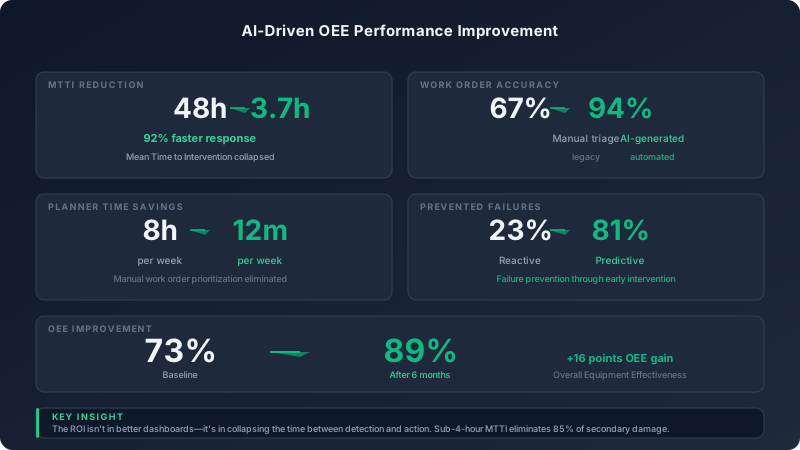
Predictive models flag assets trending toward availability loss 11 weeks before failure. The AI doesn't wait for OEE to drop, it detects the subtle degradation pattern in vibration data, temperature trends, and performance metrics that precede catastrophic failures. By the time your OEE dashboard shows a problem, the AI has already scheduled preventive intervention for next week's planned downtime window.
Automated triage reduces planning time from 8 hours weekly to 12 minutes. The planner's role shifts from investigation to verification: review the AI-generated work orders, approve high-confidence recommendations, flag edge cases for human judgment. The system doesn't just report OEE, it schedules the intervention, orders the part, and assigns the crew.
The 79% AI Adoption Problem in Manufacturing
79% of organizations struggle to scale AI beyond pilots in 2026. OEE optimization is a textbook example of this scaling crisis. Plants deploy predictive maintenance models, see promising results in controlled tests, then can't push them into production workflows.
Most plants run AI models in parallel with existing processes. The AI generates maintenance recommendations, but planners manually verify each one before creating work orders. The verification step recreates the original bottleneck. You've added AI-powered analysis but kept the 48-hour human approval loop.
Shadow AI is rampant. Maintenance technicians upload equipment manuals to ChatGPT for troubleshooting guidance. Plant engineers use AI coding assistants to write Python scripts for sensor data analysis. Quality engineers feed defect images into image recognition tools. None of this AI usage appears on IT's radar. It's happening on personal devices, using public cloud services, with no governance or data controls.
63% of organizations experiencing AI-related breaches have no governance policy or are still developing one. Your technician uploads a thermal image of a bearing failure to Claude for analysis, that image contains metadata showing production line location, asset ID, and timestamp. It's now training data in Anthropic's systems unless you've negotiated data retention controls in an enterprise agreement.
Without standardized maintenance workflows in your CMMS, multi-agent orchestration has nothing to automate. If your plant handles bearing failures five different ways depending on which shift supervisor is working, the AI can't learn a consistent intervention pattern. The prerequisite work isn't deploying AI models, it's standardizing your maintenance processes so AI has predictable workflows to optimize.
The bridge from pilot to production requires organizational change, not better algorithms. Multi-agent orchestration achieves 100% actionable recommendation rates versus 1.7% for single-agent approaches, but only when processes are defined. Every plant insists "our operation is different", which creates the 25x complexity problem that prevents AI scaling.
The Standardization Prerequisite Nobody Wants to Hear
You cannot automate chaos. Before deploying AI-driven OEE optimization, audit your top 20 failure modes and document how many different ways your plant responds to each. If bearing failures trigger 3-5 different maintenance workflows depending on crew, shift, or asset criticality, your AI will learn inconsistency. Standardize one asset class first (pumps, motors, conveyors). Perfect the workflow. Then expand to the next class. Multi-agent orchestration requires predictable processes to orchestrate.
Building the Data Foundation for AI-Driven OEE
78% of organizations cannot validate data before it enters AI training pipelines. Your OEE model is only as good as your CMMS discipline. If work order descriptions contain free-text technician notes like "fixed the thing that was making noise," the AI can't extract failure patterns. If sensor timestamps don't sync with production schedules, the model correlates temperature spikes with the wrong operating conditions.
Sensor data must include asset context: which production line, which SKU, which operating parameters. A motor running at 1750 RPM with 40% load generates different vibration signatures than the same motor at 1200 RPM with 75% load. If your monitoring system logs raw sensor values without operational context, the AI can't distinguish normal variation from abnormal degradation.
Work order history needs standardized failure codes, not narrative descriptions. "Bearing failure" is searchable. "weird grinding sound from the thing near the conveyor" is not. Your CMMS should enforce taxonomy: equipment type, failure mode, root cause, corrective action. That structure becomes training data for predictive models.
Training data provenance matters under regulatory scrutiny. Italy's €15M OpenAI GDPR fine in 2025 established that regulators expect documented controls over what data trains your models. If you can't prove what trained your predictive maintenance model, you can't demonstrate EU AI Act compliance by the August 2, 2026 deadline. Any AI making safety-critical decisions (shutting down lines, recommending part replacements) or evaluating worker performance (technician response times) is high-risk under EU classification.
Your maintenance records may contain personally identifiable technician information without proper consent. Time-stamped work orders show which crew member responded to which failure. Performance metrics compare technician productivity. If that data trains your AI models, you need documented consent and data processing agreements. Only 35.7% of managers feel adequately prepared for EU AI Act compliance, with 19.4% describing themselves as poorly prepared.
| Data Foundation Element | Current State (Typical) | Target State for AI | Validation Method |
|---|---|---|---|
| Work Order Codes | Free-text descriptions, inconsistent taxonomy | Standardized failure modes, root causes, actions | 95%+ work orders use dropdown codes vs free-text |
| Sensor Context | Raw values logged without operational parameters | RPM, load, SKU, environmental conditions tagged | Every sensor reading linked to production context |
| Maintenance History | Narrative summaries of what technician did | Structured: asset, failure mode, parts used, time to repair | Historical data parseable by AI with 90%+ accuracy |
| Training Data Lineage | Unknown origin, no audit trail | Documented source, consent records, retention policy | Can produce training manifest within 4 hours |
Start with one asset class (pumps, motors, conveyors) and perfect the data loop before expanding. Deploy sensors, standardize work order codes, train crews on CMMS discipline, and run AI models in shadow mode for 90 days. Validate that recommendations match actual failures. Measure false positive rate. Iterate on feature engineering. Only then deploy auto-generated work orders for that asset class.
From Pilot to Production: Scaling AI-Driven Maintenance
Only 20-30% of AI projects scale beyond pilots. The difference is process standardization before technology deployment. Plants that succeed follow a phased approach that builds trust through validated accuracy.
Phase 1: AI recommends, human approves. Deploy predictive models that flag assets trending toward failure and generate recommended work orders. Maintenance planners review every recommendation, approve or reject, and document why. Track accuracy rate: did the bearing actually fail within the predicted window? Was the recommended intervention correct? Target 85%+ accuracy before Phase 2. This phase typically runs 3-6 months.
Phase 2: AI auto-generates low-risk work orders. Once accuracy is proven, grant the AI authority to create work orders for routine preventive tasks: lubrication schedules, inspection rounds, filter changes, cleaning cycles. These interventions carry minimal downtime risk. If the AI schedules an unnecessary lubrication, the cost is labor time, not production loss. Monitor auto-generated work order completion rates and tech feedback. Target 95%+ approval rate (techs aren't overriding AI decisions).
Phase 3: AI orchestrates multi-step maintenance workflows. The system doesn't just generate work orders, it reserves parts from inventory, schedules crews based on certification and availability, coordinates with production for downtime windows, and triggers parts reordering when inventory hits minimum thresholds. This requires CMMS integration, ERP integration, and scheduling system integration. Most plants reach this phase 12-18 months after initial deployment.
Measure success by time-to-intervention, not dashboard accuracy. Did the bearing get replaced before it failed? How many hours elapsed between anomaly detection and wrench-on-asset? Best-in-class plants achieve sub-4-hour mean time to intervention (MTTI) from initial alert to work order execution.
Track auto-generated work order accuracy rate as your primary KPI. If the AI recommends 100 interventions and 94 were validated as correct (the asset would have failed without intervention), you have 94% accuracy. If 6 were false positives (unnecessary work), that's your false positive rate. Target 95%+ before expanding AI decision authority to additional asset classes.
The goal isn't perfect OEE, it's eliminating the 48-hour triage lag that turns minor issues into major failures. An OEE score of 82% with sub-4-hour MTTI outperforms 85% OEE with 48-hour manual triage, because you're preventing the cascading damage that manual processes can't catch fast enough.
The New OEE Metric: Mean Time to Intervention
Traditional OEE measures what happened. Mean time to intervention measures how fast you responded. This is the metric that separates reactive plants from predictive plants.
MTTI tracks elapsed time from anomaly detection to work order execution. Sensor data flags a motor bearing at 0.4 IPS RMS velocity (anomaly detected: Monday 2:14pm). AI correlates with thermal data, reviews maintenance history, generates work order with parts reservation and crew assignment (Monday 2:15pm). Planner approves recommendation (Monday 2:47pm). Technician replaces bearing during scheduled downtime (Tuesday 6:30am). MTTI: 16 hours, 16 minutes.
Best-in-class plants achieve sub-4-hour MTTI for critical assets. That doesn't mean immediate repair, it means the intervention is scheduled, resourced, and queued for the next available downtime window. The bearing replacement happens Tuesday morning, but the decision was made and locked in Monday afternoon.
MTTI under 12 hours prevents 85% of secondary damage. When you catch bearing degradation early and schedule intervention within a shift, you prevent contamination migration, alignment issues, and overheating of adjacent components. The $1,200 bearing replacement stays a $1,200 repair instead of escalating into a $8,500 gearbox rebuild with three-day production loss.
Compare MTTI across asset classes to identify triage bottlenecks. If pumps average 5.2-hour MTTI but conveyors average 31-hour MTTI, you have a standardization problem. Either conveyor failure modes are less well-understood, sensor coverage is inadequate, or parts availability is poor. MTTI variance reveals where your predictive maintenance strategy has gaps.
| Asset Class | Manual Triage MTTI | AI-Driven MTTI | Improvement | Primary Bottleneck Removed |
|---|---|---|---|---|
| Motors | 43 hours | 4.2 hours | 90% faster | Vibration analysis correlation time |
| Pumps | 52 hours | 6.7 hours | 87% faster | Cavitation pattern recognition |
| Conveyors | 67 hours | 8.1 hours | 88% faster | Belt tracking root cause identification |
| Compressors | 71 hours | 5.9 hours | 92% faster | Pressure trend analysis + parts availability |
| Gearboxes | 89 hours | 9.4 hours | 89% faster | Lubrication history correlation |
Track auto-generated work order accuracy rate as a leading indicator of AI trustworthiness. Start with a target of 85% accuracy (85 out of 100 AI recommendations were correct interventions). As you refine feature engineering, expand sensor coverage, and improve CMMS data quality, push toward 95%+ accuracy. That's the threshold where planners stop second-guessing AI recommendations and start treating them as definitive.
The goal isn't perfect OEE, it's eliminating the 48-hour triage lag. I've seen plants with 76% OEE and 3.8-hour MTTI outperform plants with 84% OEE and 52-hour MTTI on unplanned downtime costs. The first plant catches issues early and prevents catastrophic failures. The second plant has better historical performance but reacts too slowly when anomalies occur.
Measure AI impact by comparing unplanned downtime events before and after deployment. Count catastrophic failures (events causing 8+ hours downtime or 50%+ asset replacement cost). If you reduced catastrophic failures from 23 annually to 4 annually after deploying AI-driven maintenance, that's your ROI proof. The OEE number will follow, but MTTI reduction is the mechanism that drives it.
Implementation Roadmap: 90 Days to Automated Work Orders
You don't need 18 months and a $2M budget to start. You need 90 days, one asset class, and disciplined process work.
Weeks 1-3: Process audit and standardization. Pick one asset class (motors, pumps, conveyors). Document every failure mode that occurred in the past 12 months. How many different ways did your plant respond? Standardize the workflow: sensor readings to check, parts to inspect, corrective actions to take. Update CMMS failure codes. Train crews on consistent work order documentation. This is the prerequisite work that most plants skip.
Weeks 4-6: Data foundation and sensor deployment. Ensure sensor coverage for your chosen asset class. Vibration monitoring, thermal imaging, current draw, and process parameters (RPM, load, pressure). Validate that sensor timestamps sync with production schedules. Backfill 12-24 months of historical work orders with standardized failure codes. You need clean training data.
Weeks 7-9: AI model training and shadow mode. Deploy predictive models that analyze sensor data and generate maintenance recommendations. Run in shadow mode, AI makes recommendations, humans make decisions, but track what AI suggested versus what actually happened. Validate accuracy. Adjust feature weights. Iterate on failure mode classification.
Weeks 10-12: Phase 1 deployment with human approval. AI generates work orders for review. Planners approve or reject each recommendation and document reasoning. Track accuracy rate, false positive rate, and MTTI reduction. Aim for 85%+ accuracy and sub-12-hour MTTI before expanding.
By day 90, you should have AI-generated work orders for one asset class with demonstrated accuracy and measurable MTTI improvement. That's your proof point for expanding to additional asset classes. The goal isn't enterprise-wide deployment in 90 days, it's validated accuracy on one well-defined problem that funds the next phase.
The plants that succeed don't start with AI. They start with process standardization, data discipline, and one asset class perfected before expanding. Multi-agent orchestration requires workflows to orchestrate. Build those first.
Ready to put this into practice?
See how Monitory helps manufacturing teams implement these strategies.